Pages

Monday, June 2, 2014

Drawing

In our final unit, Birth, the freshman class was assigned to create a poster symbolizing the food system and how it affected, affects, and will affect us, and the environment. My group decided to create an art piece symbolizing the third unit Decay, which explained how technology has affected the way people eat. With that we also chose 3 keywords that explained this time of history well. The most challenging part for my group was drawing it out, but we overcame that when  we realized that we don’t necessarily have to have a lot of drawing talent in order to show our hard work and understanding. We all are proud of how our art piece came out. We all helped each other when one needed help. When the class is finished we will put all posters together, to represent the four units, Life, Death, Decay, and Birth. When we put them together, it will represent the new understanding we have about the food system.

GS(2014).Food for thought.
Artist statement
Our poster represents the third unit, Decay. In this unit our class learned about the industrialization of food, the American diet, and the food industry. The unit is called Decay because we studied how technology has influenced the way people are eating. We illustrated the American diet, the food industry, and the Green Revolution. We represented the American Diet by drawing a globe and a conveyer belt. The globe symbolizes how most of the world relies on fast food, or more specifically McDonald’s. The conveyor belt represents our food system, and the distribution process that animals and our food have to go through. We then drew a factory where our food is processed. The man outside the factory is not actually planting flowers, but painting them out. He represents how the nation puts a “band aid” to cover the truth on how our food gets to our table. The truck shows how the final step in the food industry is to finally ship out all the food. From the factory the truck is pulling out with boxes in the back, which is the food. Each box represents a fast food chain, to show how that food gets to a restaurant. We then drew a tractor connecting with the food system by having the conveyor belt as a wheel. The tractor is on road that connects all four units together. We drew an average American fast food meal, walking its way to the globe, or to its home McDonalds. We represented the Green Revolution by drawing the “Father of the Green Revolution”, Norman Borlaug, injecting fertilizer and chemicals into wheat. To represent the harm these fertilizers and chemicals do to crops, we drew an empty bottle of poison on the ground. We wanted to capture all the elements of this unit so when people look at it they get a sense of what is going on.

AMK(2014). Food for thought.

anti-GMO

For this “Food Class,” a combined math and science course, we have been learning about Genetically Modified Organisms and Plant Genetics, and about how GMOs are used in fruits, vegetables, and also in humans. We have learned the reason that GMOs are being inserted into products. But this speech will tell you about why you shouldn't eat products with GMOs.

 GMO stands for genetic modified organisms means is an organism whose genes have been changed by scientist by a purpose.

I am anti-GMO. I want my community to be healthy. I want nature to take control of itself, because we are experimenting on ourselves when we eat these foods. Other products that we use, like cars and prescription drugs, must be tested, sometimes for years, before they can be sold. But GMOs don’t have to be tested, or even disclosed. I believe that GMOs shouldn't be allowed to be sold until they are proven safe for our health. This is the least we can do. 

I am anti-GMO because GMOs are not proven safe. They’re not that nutritional compared to organic fresh products being grown in a garden. GMO products into which genes have been inserted to prevent bugs from eating them that then we eat may cause health problems. These GMO products are not good for us because they are less nutritious. Yes, GMO products in the stores are less expensive but dangerous for our bodies, therefore organic foods are Non- GMOs which is way better for us because (One) it’s naturally grown and fresh (Two) Reduces health risk (Three) They taste great (Four) Conserves water resources and (Five) Farmers build healthy soil. This is why you should switch to eating organic products because of these top five reasons.

This graph shows the maize supply between France, a non-GMO country and U.S.A, pro GMO country.
France: 2007 - 2008 and 275 grams and 293 grams = 6.5%  Increased maized production.


Be Anti- GMOs to help the community build a healthy place. Gm foods are not proven safe, which will not cause immediate health problems. This is important for us to know and be aware of all the things we are eating that are GMOs.

Any GMO products should contain a label to let people know what are they eating and putting in their bodies. GMO products are bad because they’re less nutritious, purposely made cheaper, and GM crops kill genetic diversity and promotes monoculture.

Arguments

Argument 1: For this argument, GM foods might have health risks for people. It is unnatural to put fish genes in a tomato plant. When you do that it creates potential allergies that might not be there if you ate an organic tomato. The effects of these foods are not known to us. Eating these food might upset our stomachs

Argument 2: For this argument, GM crops kill genetic diversity and promotes monoculture. Genetic diversity is a variety of genes within an organism's species. Monoculture means one crop being grown over and over. Monoculture is bad for the environment because the crops become vulnerable to diseases and pests.

Argument 3: For this argument, GM farmers become slaves to big corporations. Monsanto is suing farmers for using their patented GMO seeds without paying as result these small farmers are in debt and can’t afford to keep their farms.

These are some reasons why GM foods are not beneficial to humans. GM products are being inserted with genes that are capable of hurting plants and humans. These are fake chemicals that are in these fruits and vegetables that we eat nowadays.

Vote For anti-GMO!

Friday, May 30, 2014

Order # 12

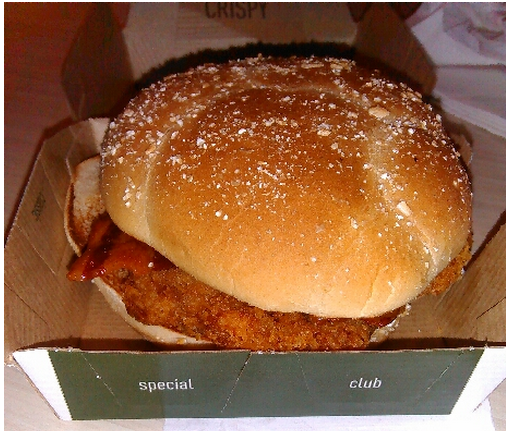
For this unit of humanities I have learned about industrial foods and how technology is used to create our foods today. For this action project I compared a restaurant meal and a homemade meal with a food review explaining which meal was better, healthier, and which one filled you up faster than the other meal. For the restaurant meal I went with my dad to Mcdonald’s and ordered a chicken sandwich. For the homemade meal I went to the grocery store and bought the items to make my sandwich. I bought white bread, turkey bacon, and chicken patties. I cooked my homemade meal by myself, but I had a hard time cooking the bacon because my oil was too hot. This course “Food for Thought” has impacted me to eat more healthy because the process in which meat was processed made me change my way of eating meat.

Food #1 Restaurant
At the Mcdonald’s on 4338 W. North Ave I ordered a #12 Chicken Ranch BLT Crispy. It was a pure salty meal with a side of salty fries and a cold drink. After awhile, I got used to the taste. While eating, it tasted very delicious had a wonderful smell and nice great texture while grabbing the burger. I could taste the salty and sweet sauce of ranch burst into my mouth, with bits of bacon so crunchy. I could hear myself crunching very loudly inside my head. I loved It. I was full after I ate everything I had ordered. All I smelled was ranch, the sauce that gave it the most flavor.

rsz_screenshot_2014-05-27_at_122428_pm.png
Photography. JR (2014).
Food #2 Homemade
For homemade food, specifically sandwiches, my favorite sandwich flavors are turkey and smoked ham. However for this homemade sandwich, I used white bread, chicken, bacon, pickles, ranch and  honey mustard. My sandwich turned out to be more greasy, salty and less crunchy than the McDonald's BLT version. The amount of ranch and mustard made the bread softer and less appealing to the eye. In addition, the chicken patty was really greasy and not as crunchy. My meal wasn't as tasteful as the McDonald's famous BLT. I personally did not feel full because I did not like the turnout, therefore I did not eat it all.
Photography. J.R. 2014.

The ranch had a lot of ingredients that I have never heard of before and one of them was disodium guanylate. This ingredient is safe to eat and enhances the flavor that ranch dressing has.

Michael Pollan’s 5 transformations described major ways that our diet has changed since the industrial revolution. One of the transformation is from whole foods to refined foods. I chose this transformation to relate to my meals because my Mcdonald’s sandwich was made with white bread which is a refined food. The ingredients that I put in my homemade sandwich were also refined. For example, the dressings were processed because I read the ingredient label on the back and didn’t know what any of the ingredients were.


I recommend the Mcdonald’s chicken sandwich because the bread was less soggy and way tastier. The homemade sandwich that I made was very soggy and just didn't taste the same as the Mcdonald’s chicken sandwich. They were both greasy and also salty. I will definitely have the Mcdonald’s chicken sandwich again.


Wednesday, May 14, 2014

The Rised Cupcakes

Cupcakes

 In “Food,” a math and science course, my classmates and I have been learning about the different chemical reaction behind cooking. We watched a movie called “Kings of Pastry”, which showed the steps of how to make delicious bake goods using the right measurements and how to mix the ingredients that the cupcakes need. I have also learned about the 5 essential ingredients used for baking which are eggs, butter, flour, sugar and baking powder. The most challenging thing was finding the right measurements that needed to be put into the cupcake as a substitute for baking powder.

My Cupcakes Lab Report
 For my lab report, I have chosen a base and acid to put into my cupcakes to see if the cupcakes will turn out just as if it had baking soda. After we put in molasses and egg white, it turned out that the cupcakes had rose a little bit. I thought it would not rise without baking powder. I wanted to know how my cupcakes will turnout to be if I would add egg whites and molasses to get the same reaction as if it was baking powder. I chose to put in molasses which has a pH of 6 and egg whites with a pH of 8.5 so that I can create an acid-base reaction. When they react, they create bubbles which make the cupcakes rise.

Research Question : Can I create the effects of a leavening using of an acid and base?

Hypothesis: If I put egg white and molasses together, then it will make my cupcakes moist and rise just as high as baking powder.

Materials: 
 1/12 cups of sugar
 1/24 cups of butter
 ⅙ of eggs
 ⅙ Tsp of Vanilla extract
 3/24 cups of all-purpose flour
 1/24 cups of milk

Procedure: 

For Control Group:

1. Preheat oven to 350 degrees F (175 degrees C).
2. Grease a muffin pan.
3. In a medium bowl, cream together the sugar and butter.
4. Beat in the eggs, one at a time, then stir in the vanilla.
5. Combine flour and baking powder, add to the creamed mixture and mix well.
6. Finally stir in the milk until batter is smooth.
7. Pour or spoon batter into the prepared pan.
8. For cupcakes, bake 20 minutes.

For Experimental Group:

1. Preheat oven to 350 degrees F (175 degrees C).
2. Greased a muffin pan.
3. In a medium bowl, cream together the sugar and butter.
4. Beat in the eggs, one at a time, then stir in the vanilla.
5. Added molasses, egg white, flour and mix well.
6. Finally stir in the milk until batter is smooth.
7. Pour or spoon batter into the prepared pan.
8. For cupcakes, bake them for 20 minutes

Data


Cupcakes
Amount of Molasses (TSP)
Amount of Egg Whites (TSP)
Height of Cupcakes
1
1/16
1/16
3.7 Cm
2
1/32
3/32
3.4 Cm
3
3/32
1/32
3.5 Cm
4
0
1/8
3.7 Cm
5
1/8
0
3.3 Cm
6
2/48
4/48
3.1 Cm
Control Group
-
-
4.25 Cm


Graph
This graph shows the height of the cupcakes that my friends and I baked.


Recipe in Metric
This is the winning cupcake recipe that I will submit to the magazine.


Ingredients
Amount in Cups/Tsp
Amount in mL
Sugar
1/12 Cups
20 mL
Butter
1/24 Cups
10 mL
Eggs
40 mL
Vanilla Extract
⅙ Tsp
0.83 mL
Molasses
0
0 mL
Flour
3/24 Cups
30 mL
Milk
1/24 Cups
10 mL
Egg Whites
⅛ Tsp
0.625


Conclusion In conclusion I disapprove my hypothesis because my cupcakes did not rise as high as the cupcakes in the control group. This is because an acid-base reaction did not occur since I didn't add any molasses in the 4th cupcake. This was my favorite cupcake because it was crunchy.

Thursday, May 8, 2014

The Ingredient: Grape

For this course "Food For Thought" I was to choose a ingredient and research where it comes from and from how it gets to your plate at home. I learned that grapes are not only a fruit but are used for many things, like medicine, wine production and other foods products that have grapes in it also.The most challenging thing was to research a company and see the process in which, it is transported and taken to you local super market. I chose the "Delano Farms Corporation" company but didn't have any details about how they transport their grapes and how they are processed. What I am most proud of is that I researched a lot and from so much research I had lots of sources to find out how they get their grapes processed and transported to states and countries all around the world.

Monday, April 28, 2014

My organic garden

In my “Food” course, we are learning how to create a garden and the different ways that soil is living or dead. For this project, we designed our own virtual organic garden. Creating my raised bed took a long time to figure out the dimensions. I am planting 10 different plants which are tomatoes, potatoes, peas, peppers, alfalfa, onions, carrots, lettuce, strawberries and radishes. These plants will be planted in my backyard garden where there are also other plants and plenty of soil to grow these beautiful plants.


The length for my bed is 48 inches which I converted to 4 feet. The width is exactly the same as the length. The height is 24 inches which I then converted to 2 feet by dividing my inches by 12. The volume is 55,296 cubic inches. This is how much soil I need in my garden. I have also recorded the process of plants pH levels in order to know my plant will develop complete and be healthy. Also, I learned that plants have to have 5.5-7.0 of pH level to keep itself in good condition.The soil that I collected from my backyard has  pH level of 7.0. Nitrogen is N3 sufficient, Phosphorus is P2 adequate and Potassium is K4 surplus. The reason why I conducted a soil sample test was to know if the quality of my soil was good enough for my plants. I learned that I needed to add 0.32 pounds of soft rock phosphate and I don’t need to add potassium and nitrogen fertilizers to my soil. From my soil observation that I collected from my backyard the soil had compost, insects and was very moist and that’s how I knew that my soil was living because worms like to live in good soil.


The 10 plants that I will plant are tomatoes, carrots, onions, lettuce, radishes, peas, peppers, potatoes, strawberries, alfalfa. some are companion plants like lettuce and onion, because onions has a very strong smell and insects don’t like to eat it. By growing lettuce next to onions, onions will be helping lettuce from getting eaten by insects underground. Companion plants are plants that grow well together because they have a mutual relationship that help each other grow. Tomatoes helps carrots by providing them with good flavor. Alfalfa is a nitrogen fixer, which means that it collects nitrogen from the atmosphere and converts it to nitrates, nitrites and ammonia. This adds nitrogen in the soil. Companion planting is very helpful to plenty of plants here in the U.S and many other countries. Plants help each other from getting damage, by providing sunlight, shade, or repelling insects from getting eaten.


In conclusion I learned that not all gardens need fertilizers. I would be interested into planting this garden in my backyard.

By:  J.R (2014)  My Raising Bed 


Tuesday, April 22, 2014

Bobby the Banana

For this course I am taking a "Food For Thought" class. We are talking about ingredients that are put in foods in markets that we buy. Also, the major products that are put in products nowadays have ingredients that we are not familiar with or aware of.  For example, corn is a vegetable that is put in mostly everything. This is why we want to go deep into these ingredients and see how they developed and how and why they are how they look and taste. For this Project, we were assigned to design a family tree with the roots of our families and all types of favorite foods they liked. These favorite foods of my family all have background ingredients that I don't know. A famous thing that we eat at home is Plantain, "Plantano" in Spanish. I decided to research plantain and learn the interesting characteristics about bananas and different ways they can be cooked. Here is a autobiography of plantains.


"Family Tree". 2014 By. J.R.
Hi I’m Bobby the Banana, I am also known as Plantain. I am a very well known product from all around the world. I originated from Southeast Asia to the South Pacific around 8,000 to 5,000 BCE. In early 3,000 BCE Bananas were dispersed far and wide across the tropics, in all directions. Therefore, plantains may have been growing in Eastern Africa in the early years of 3,000 BCE. As you may know “Banana” is the typical name that we call plantains nowadays. “Banana” is the name given to those plants that produce a sweeter form of fruit. There are about fifty recognized brothers and sisters of mine, which is pretty awesome.

In many cultures I am put in their foods like rice, which goes perfect. I love being sweet. There’s so many ways to cook me and eat me! I can be fried, cooked, smashed and also baked for banana bread as well. I have traveled all around to many countries. They just love me too much. I love to be shipped to other countries, it's a very amazing ride. Sometimes when people buy me, they leave me in their kitchen for so long that I start to rot and get nasty, but sometimes I still get eaten. It's very easy to peel me when I am ripped because I get softer and a little bit weak. After I am ripped, my outer skin usually is dark brown or black.

I grow well in non-tropical climates. My temperature has to be around 50 degrees Fahrenheit. My siblings and I have been cultivated in nearly all tropical regions of the world. Africa is the home of the African highland banana. After I am disseminated all around the world, I get brought to food markets that buy me and my family in boxes. We get put in baskets and bags after we are shipped to these markets. When we're all settled, we get bought by people that shop and buy products from the food market or grocery store. People usually put us in bags in dozens. It gets very hot in there sometimes. Then, we travel to the person's house who bought us. When we are there we are set on counters or in pantries.

Sometimes me and my family just sit there for so many days without being cooked, which is good, but then we start to rot and smell extremely bad. We bananas don't use deodorant. You have to cook us quick that way you can enjoy the tasty flavor we have. "Plantains are so good" I heard this girl's mom say, but when we are put in a kitchen with my other fruit friends, I get peeled and cut into slices, which hurts but not that bad. I get fried for about 6-7 minutes on one side, then flipped so that way I am fully cooked and ready to be set in a plate. We are usually always combined with lots of rice. After I am put in a plate I get eaten and then more of my siblings are grown and grown again.

Sincerely, "Bobby The Banana" Age 34
Born In 1822 Died In 1856.

Sources

Custom Home | Promusa - Mobilizing Banana Science for Sustainable Livelihoods." Custom Home | Promusa - Mobilizing Banana Science for Sustainable Livelihoods. N.p., n.d. Web. 15 Apr. 2014.

Agricultural Biodiversity." Researching Agricultural and Forest Biodiversity. N.p., n.d. Web. 15 Apr. 2014

MUSALAC." MUSALAC. N.p., n.d. Web. 15 Apr. 2014.